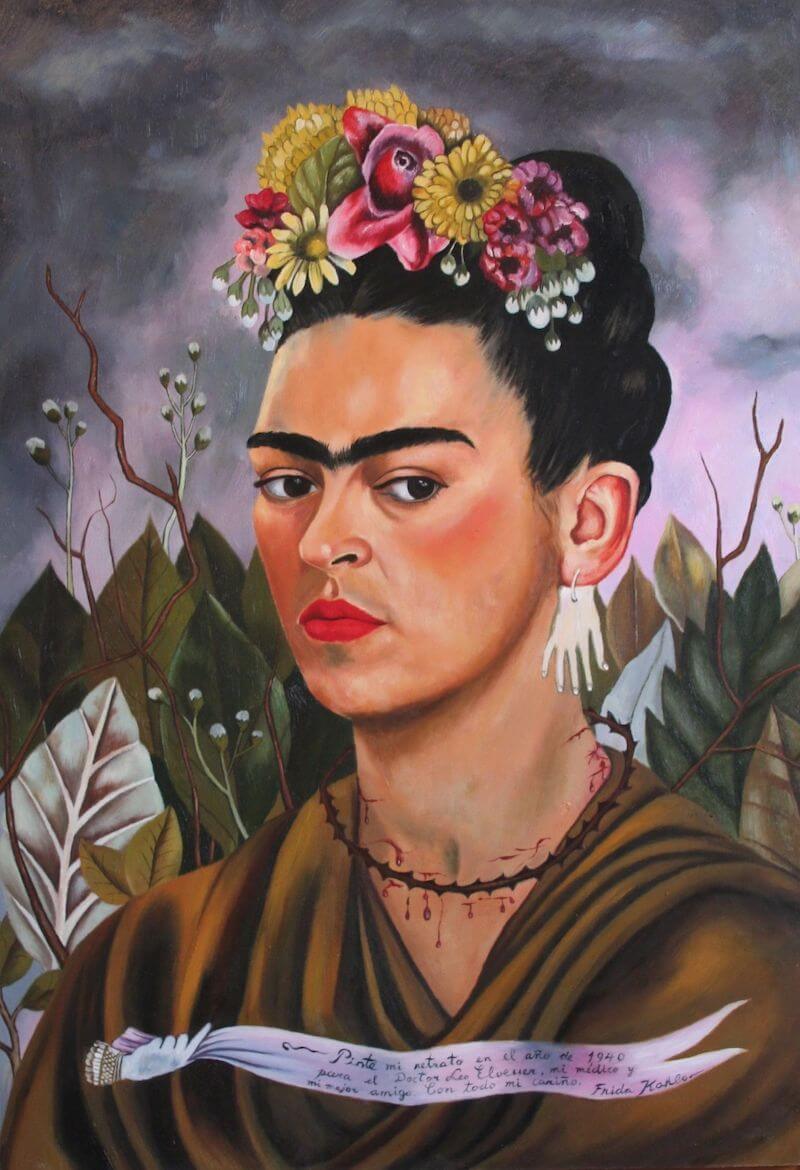
Self Portrait, Dedicated to Dr Eloesser, 1940 by Frida Kahlo
Christian imagery, especially the theatrically bloody martyrdoms that hang in Mexican churches, pervades Frida's iconography. Her house in Coyoacan displays a particularly gruesome Road to Calvary, in which the overemphasis on Christ's wounds seizes the spectator on the most primitive physical level. This bloodiness and self-mortification hark back to preconquest times, when the Aztecs tore out human hearts and punctured their own skins to ensure life's continuance. But it was Spanish Catholicism that brought to Mexico the depiction of pain in veristic and human terms, creating images so real and so frightening that the Indians could not help but be awestruck and, of course, converted. Borrowing the rhetoric of Catholicism, Frida used the same combination of pain and realism to attract devotees to her cause.
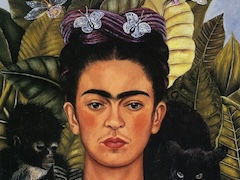
In another 1940 Self Portrait, Dedicated to Dr Eloesser Frida's necklace of thorns is just a single strand, but it draws even more blood. In the background, leafless broken-off twigs profiled against an opalescent sky look like the dead twigs woven into Frida's necklace in the self-portrait with the hummingbird. No doubt the dry white buds that mingle with the twigs (and that droop from Frida's headdress as well) likewise refer to her desolation. Although Frida has flowers in her hair and wears the earrings in the shape of hands that Picasso gave her when she was in Paris, she looks like someone dressed for a ball for which she has no escort.
Frida's work from the year in which she and Diego Rivera were separated demonstrates a heightened awareness of color's capacity to drive home emotional truths. As a self-taught artist, she began with a highly personal and unorthodox feeling for color. Her palette came out of her love for the startling combinations of bougainvillea pinks, purples, and yellows seen in the decorative arts of Mexico. She chose colors the way she chose her clothes - with exquisite aesthetic calculation. In such early works as Henry Ford Hospital, pastels create an ironic disjunction with the painful subject matter. In later paintings the choice of colors is just as odd and often even more dissonant and complex. The soft, pearly sky and the bright flowers in the Eloesser Self-Portrait, for example, only accentuate the chill of Frida's predicament. Their richness recalls the way statues of the scourged Christ in Mexican churches are often surrounded by flowers, lace, velvet, and gold.